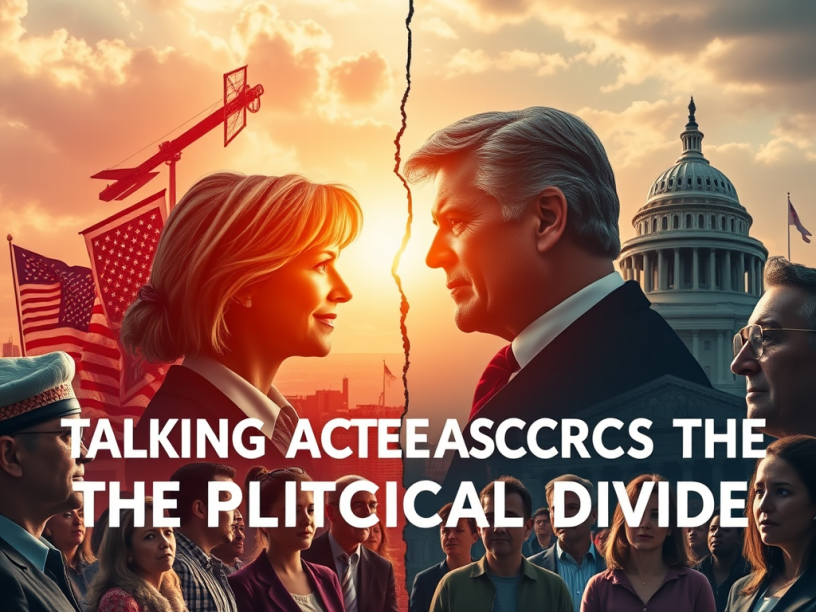
A rational critique of discussion on WHYY
It has been my experience that many academics fail to look at modern problems critically through the lens of history and psychology. Today, I was in the car listening to my local NPR station, where there was a discussion “Talking Across the Political Divide,” that referenced the factionalism that we see occurring in this country and the polarization between left and right in the government and electorate. The discussion featured a clinical psychologist, William Doherty andLia Howard a political scientist who created an organization called “Braver Angels,” a bipartisan group that is supposed to foster discussion across part lines. While I like the “noble” sentiment of their cause, they appear to be ignoring the “big picture,” which relates to how power is manifested and maintained in government. It is a noble, liberal tendency of academics, to believe that they can discuss and debate there way through a complex reality an ascertain a “happy” middle-ground where all parties will come together in a grand “Kum Baya” moment. Our tacit acceptance of liberalism in the academic world is often contrasted by the harsh reality of historical reality and human nature. To the academic, who stresses the value of bibliographical refences, it appears that their own initiatives require no scientific or philosophical support, only liberal “good will,” dialogue and debate. Let’s take a short walk to the library and dig into this dilemma as social scientists.
Aristotle may have been one of the first to say,” anthrōpos politikon zōion”, or” man is a political animal” over 2300 hundred years ago, yet we can find many inferences throughout history that shows that man is not only political, but he is also highly self-interested. Self-interest exerted in political systems can corrupt even the most idealistic, liberal forms of government, as was duly expressed by one of our founding fathers, James Madison. Man, the political animal, has formulated a variety of different political systems, all of which have been subverted by self-interest.
“Ambition must be made to counteract ambition. The interest of the man must be connected with the constitutional rights of the place. It may be a reflection on human nature, that such devices should be necessary to control the abuses of government. But what is government itself, but the greatest of all reflections on human nature? If men were angels, no government would be necessary. If angels were to govern men, neither external nor internal controls on government would be necessary.”
Federalist 51
Madison recognized the danger of factionalism, noting that the interests of the nation must come before the interests of any one group that is part of the constituency of the nation. So, if we were duly warned, why have we lost our way? I can choose either Nietzsche or Hobbes, to explain how political systems can be subverted, for both men had a keen understanding of human nature.
Yet, one of the more eloquent theories regarding asserting power through factionalizing the populous, comes from Paulo Freire, in his book Pedagogy of the Oppressed, (1967) where he discusses the creation of an “anti-dialogical” society, so that the elites can maintain control through the inability of different groups to maintain dialogues that might lead them to question the government. If we look at the current landscape in this country, we see a polarized nation, segmented into special interests of individuals, rather than the good of the nation. This is the essence of antidialogical reality.
If we look at the manner in which the nation is polarized across political lines, we see strong, very personal divides between conservative and liberal lines. Ironically, the conservatives political play, could be scripted from Hanna Arendt’s “History of Totalitarianism,” where she shows how the elites were able to create rhetoric that made the mob believe that the elites were serving their interests. Hitler’s propaganda regarding the Jews, made the mob believe that the Jews were the cause of their problems. His racist and xenophobic rhetoric further pulled the mob together and eventually, their sentiments grew to a murderous crescendo. It is frightening to think of the United States in this fashion, but if you tuned to CNN prior to the election, you would get gain an understanding.
A psychological assessment of the right wing might begin by saying human beings are a species of atavism, an aphorism from Nietzsche’s “Will to Power.” Conservative rhetoric has its adherents looking backward in time to older value system due to a distaste for liberal sentiments and the relative direction of the nation. They have reverted to the old staples of tribalism and kinsman relationships, coupled with Christian dogma. The rhetoric, not unlike Hitler, has made the mob feel cheated and threatened, scapegoating immigrants and politicians who support liberal special interests. The conservative mob feels helpless, as they have embraced an external locus of control, not seeing how they alone can manifest change, given the script of the conservative pundits. The right has weaponized a plethora of issues from abortion, NATO, funding the war in Ukraine and LGBTQ rights. The Right was extremely effective in co-opting the mob, that consisted largely of less educated and lower income individuals, largely by driving home emotionally polarizing sentiments, that kept the masses far away from rational assessments.
The Left in past years has been pulled in a diametrically opposite direction by the “progressive” forces of the Democratic party who have corrupted one of the keywords and notions of our democratic republic: equality. Equality, in the mind of many progressives, is operationalized to mean that all “special interests” of society must be heard and embraced. If we look at the media, LGBTQ individuals are statistically over-represented, slogans like Black Lives Matters, become a battle cry against a stressed law enforcement system, dealing with the violent reality of our inner cities. In many liberal circles, religion has been supplanted by a movement towards secular humanism, which drives an even bigger wedge between Right and Left. One of the criticisms that has been bandied about regarded the 2024 presidential election is that the Democrats have become the party of the wealthy and the educated, referencing a concept I recall from my college days, “the liberalizing effect of education. “One of the criticisms of modern liberalism, is that it overvalues discussion and debate, whereby their critique of social issues creates an “agnostic sphere, the identitarian Left increasingly seeks to impose a kind of dictatorship of its own as to what is morally permissible and what is not”. (Carl Schmitt’)
As I have laid out the foundations of factionalism, we must be reminded that the sentiments on both sides are being driven home by a news media, that no longer reports only “the news that is fit to print,” but is the consort of the Left/Right ideology that they support. Our nation was warned some sixty-five years ago by Dwight D. Eisenhower, “beware the military, industrial complex.” As a general, I must believe he was warning our nation of an imminent threat on our horizon, the forces of self-interest of those who were elected to govern, and the corporations who can profit from their intimate relation with politicians. The root of our antidialogical reality is sown in the reality that both sides believe that they hold “the high moral ground,” and this is the case, there is no amount of debate or discussion that will heal the fissures between the two sides. Our inability to create dialogue enables the elites to keep a firm grip on their power and wealth.
With all this being said, I return to Dougherty and Howard’s “Braver Minds” initiative, and I have to ask whether they actually grasp the depth of the deliberate and toxic nature of the polarization and factionalism in our country. Both Left and Right have elevated the tenets of their ideals to a level of religious belief. The Greek word “orthodox” serves to describe the mindset of both sides as it translates to “right minded.” Can the liberal idea of dialogue and debate bring the two sides closer? I have often stated, “you can’t win an argument, you can only win an agreement,” but this requires compromise. The news media and political propagandists have both sides so heavily invested in their narratives, there is truly no middle ground. If we are going to move beyond this as a nation, it is going to take more than a drum circle or singing Kum Baya. To be continued…
The following is a link to the broadcast
 A Journey to the Center of Your Mind