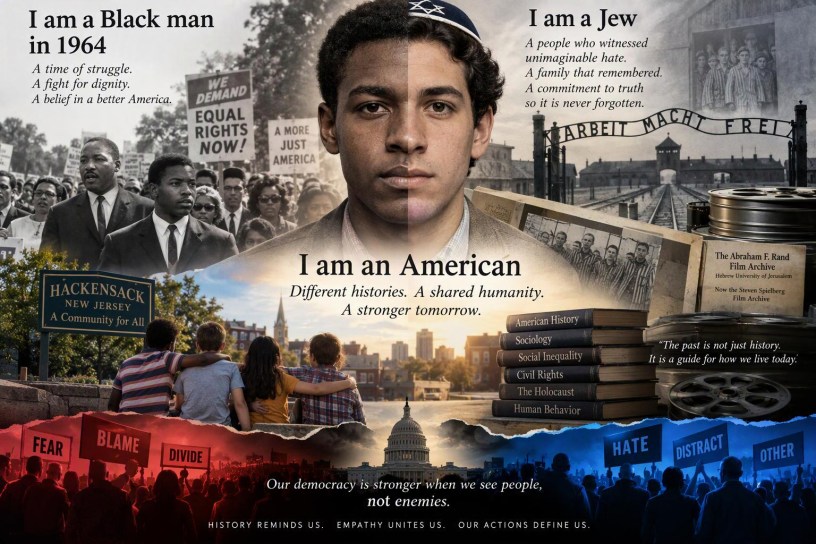
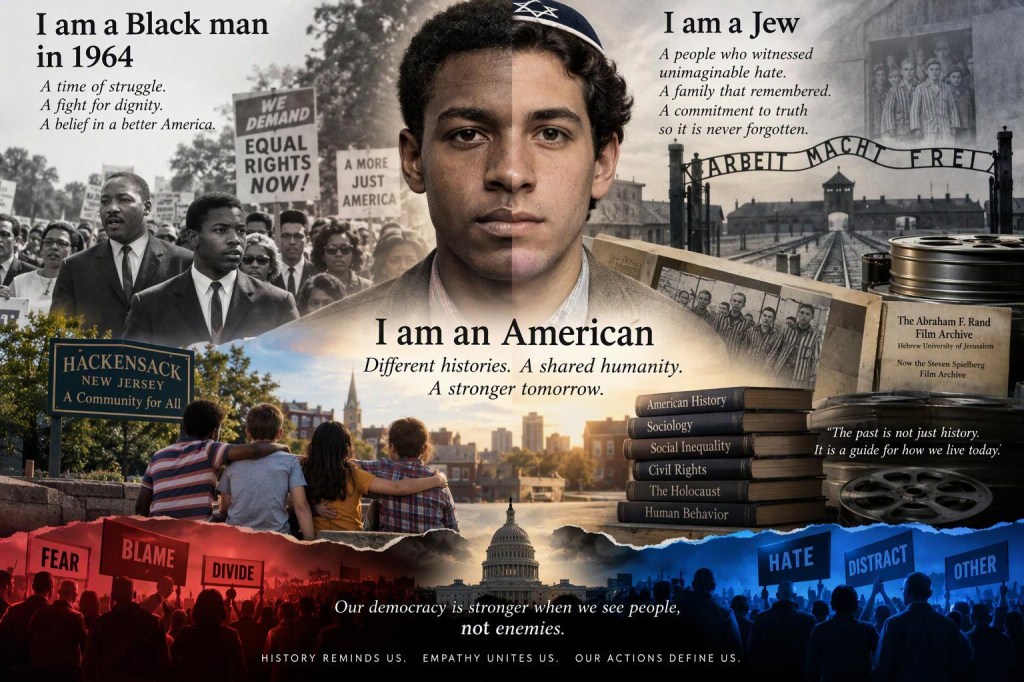
I have struggled for the past two years trying to understand how our political system has been degraded into a war of hyperbolic narratives, that have served to polarize and factionalize our electorate. My struggle comes from the academic understanding of how political movements have used these tactics to garner support for their agenda historically coupled with the often-deadly downstream effects. Sadly, the human mind is easily co-opted by narratives that demonize other groups as the source of “the problem,” while using dehumanization to make it easier to attack the group in question. In today’s terms one can consider the effectiveness of rage-baiting, which uses anger and opposition to drive themes on social media. Rage-baiting is not new, social media however is, and it has simplified the spreading of malicious narratives since most individuals will latch onto the narrative that closely aligns with the segment of the population they identify with.
I am a Black Man in 1964
I am not Black, and I was born in 1964, so the politics of the day were not really my concern. I was, however, blessed to have been born into a multicultural community, a town I refer to as the cradle of integration, Hackensack NJ. I grew up with friends who were white, black and Latino, with the privilege of being color blind. I learned about social inequality by hearing the concerns of my friends expressed, and given my social connection, caring for my friend, they became my concerns as well. My family was politically aware, and the primary topics around the dinner table were the Vietnam War, the civil rights movement, Nixon vs. Mondale and of course Frasier or Ali. Personally, I really struggled with the history of slavery, emancipation and continued social inequality, I wholeheartedly believed that we are all the same, a belief I carry to this day. My mother studied American history in college, and we would use her college textbooks as references in discussions. I guess that I am lucky that my mom saw the importance of verified sources and good information. In 1972, I remember having to ask my mother why someone shot George Wallace, we always watched the evening news together. It was a great teachable moment, I learned that there were still people in our government who openly discriminated against black people, even though the law of the land now protected their equality. Wallace was an anti-segregationist, who had peers in our legislature including Strom Thurman, Harry F. Byrd Sr and John Stennis, who were willing to fight to keep white and black people separate. Ten years later, I went to Temple University to study in one of the best urban sociology departments in the country, in my own attempt to understand what one of my professors Kyriakos Kostopoulos called social stratification and inequality.
I am a Jew
In the multicultural community where I grew up, I was part of a very small minority as a Jew. In my graduating class of roughly 620, there were six Jews and only three of us identified as Jewish. I was born nineteen years after the end of the Holocaust, to a family who was still agonizing over the loss of our relatives and of over one-third of our people. My grandfather travelled to Eastern Europe on a mission to buy the film documentation of the Nazis’ final solution from the Eastern European governments. He was able to procure two forty-foot containers of Nazi cellulose, which he donated to the Hebrew University in Jerusalem: it became the Abraham F, Rand film archive. (If you are interested in its content, it is now called the Steven S. Speilberg film archive since he gave the university a huge endowment after these films made up much of the historical body of Schindler’s List. My grandfather brought some of the films back to the US and I was privileged to see some of the short films. It is mind bending to see the horrors that men can be driven to perform in the name of hate driven by artificially constructed narratives when they become the Geist of the nation. The influence of my familial reality drove me to study the history of antisemitism, the holocaust and the psychology that underlies man’s inhumanity to his fellow man. During the 1990’s I was featured in the Library of Congress’s Speakers Bureau as an expert on antisemitism and the Holocaust and I debated both David Duke and the head of the Holocaust revisionist movement on nationally syndicated radio.
I Am an American
I have really struggled with the state of our political system for the past ten years and my frustration has reached a crescendo over our midterm elections. Having spent my life trying to understand hate and discrimination, I know that it has no place in our government as our constitution, the law of the land, protects us from these abuses. There is hate on both sides of the aisle, with each side weaponizing dangerous narratives that find appeal within segments of the electorate to unify a front that can get them elected. Our president has vilified immigrants, depicting them as criminals, driving xenophobia as a populous narrative to unite his electorate. On the left, we see a democratic socialist movement, which has crafted its own populous narratives, that appeal to a segment of the population that has little understanding of our political system or the ramifications of socialism when applied to a large, expansive, capitalist nation.
Conclusion
Today, I worry less about whether a political narrative comes from the left or the right than I do about whether it asks me to stop seeing the humanity of those who disagree with me. History has taught us that societies rarely lose their way all at once. Rather, they do so incrementally, through narratives that encourage us to fear one another, caricature one another, and ultimately view our fellow citizens as obstacles rather than as people.
As a student of civil rights, antisemitism, the Holocaust, and social inequality, I have learned that no group is immune to this temptation, and no political movement is incapable of exploiting it. The specific grievances, targets, and ideological justifications may change, but the underlying psychology remains remarkably consistent. When we abandon critical thinking in favor of tribal loyalty, and when we substitute slogans for facts, we create conditions in which prejudice and intolerance can flourish.
The solution is neither political disengagement nor blind allegiance to any party. It is a renewed commitment to the principles that have sustained our republic: respect for individual rights, adherence to constitutional protections, intellectual honesty, and a willingness to engage those with whom we disagree. These values demand that we challenge hateful rhetoric regardless of its source, that we verify information before accepting it as truth, and that we resist efforts to reduce complex social problems to simple villains and easy answers.
I am not a Black man in 1964. I am not only a Jew carrying the memory of generations lost to hatred. I am an American who believes that the lessons of both experiences remain profoundly relevant today. If our democracy is to endure, we must remember that our political opponents are not our enemies, our differences need not make us adversaries, and our shared humanity is ultimately more important than the narratives that seek to divide us.

