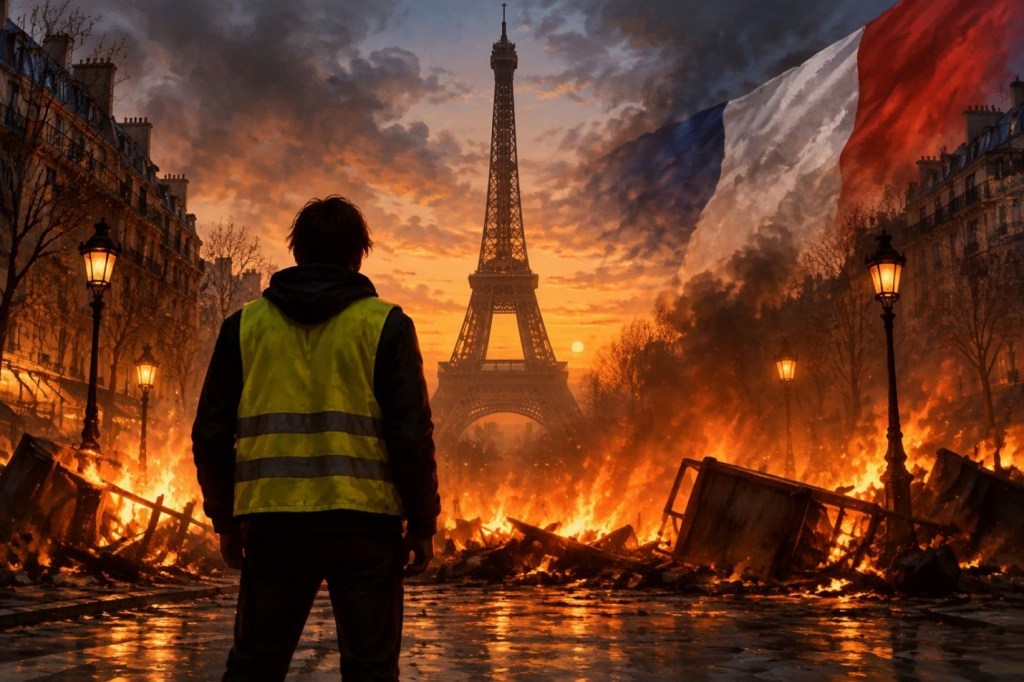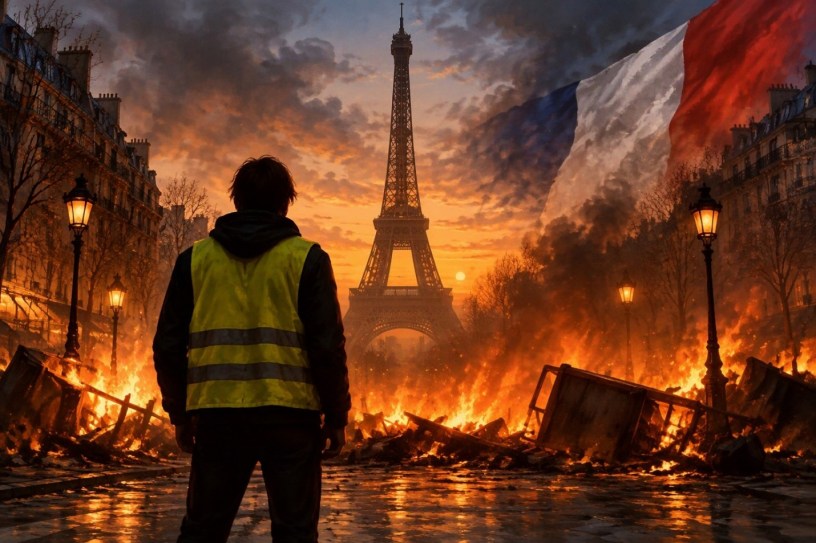
Europe is on fire, and the flames are fanned by discordant movements united only by the flag of discontent. Students, farmers, Yellow Vest protesters and young residents of the banlieues have all taken to the streets, at times violently. The news media sometimes portrays them as revolutionaries storming the Bastille, yet it rarely asks what has bred enough discontent to drive ordinary people into the street. This essay argues that no single theory explains the unrest. The best macro-level description is Émile Durkheim’s concept of anomie, but understanding how a society slides into normlessness requires several perspectives: historical, economic, political, cultural and psychological.
Anomie: A Society Without Norms
Durkheim, a nineteenth-century French sociologist, used the term anomie to describe a state of normlessness driven by the breakdown of the shared values, rules and expectations that have historically guided behavior. It emerges when rapid social change or economic upheaval causes a portion of the population to lose faith in the formal institutions and norms of society. The protesters of today differ from the revolutionaries of Dickens’ A Tale of Two Cities. Those crowds hoped to replace oppressive institutions with renewed ones. Today’s divergent groups are not bound by a shared vision of what could be; they are attempting to destroy what is. What the two eras share is a loss of faith in institutions. One French shop owner captured the rupture when she pleaded with rioters looting her shop that “this is not the way we French behave.”
The Postwar Bargain and Its Erosion
From a bottom-up perspective, France’s postwar experience was marked first by difficult reconstruction and shortages, then by sustained growth and rising living standards during the Trente Glorieuses, roughly 1945 to 1975. Leaders and institutions across Western Europe, from Charles de Gaulle and Jean Monnet in France to Konrad Adenauer in West Germany, helped guide recovery. The resulting political stability gave each generation the expectation that it would exceed the stature of the last.
That promise has weakened. Economic and cultural change, a low birth rate, an aging population and immigration have made it difficult for government to keep pace with public demands. INSEE reports that people aged 65 or over made up 22% of the French population at the start of 2026, that fertility fell to 1.56 children per woman in 2025, and that deaths exceeded births for the first time since the Second World War. Meanwhile, the cost of living has outpaced average household income, and property values and rents have risen sharply. First-time buyers in particular face high prices and new mortgage rates. These figures document demographic and economic change; they do not, on their own, prove that ageing or immigration caused declining institutional confidence. They do help explain why many citizens feel the postwar bargain no longer holds, and they raise a question for political science: has the French system drifted into political decay, or has government simply failed to adjust its policies to a changing France?
The Cognitive Schema of the State
A psychological perspective adds another layer. French society appears to have developed a cognitive schema that places responsibility for living standards on governmental institutions, while discounting the reality that government must also cope with broad shifts in global markets. French citizens expect the state to ensure employment, regulate prices, protect purchasing power and maintain social cohesion. When conditions worsen, blame falls on political institutions rather than market forces. Trust is therefore high in expectation but low in satisfaction, a recipe for chronic frustration. Responsibility for life outcomes is projected upward rather than inward.
This schema helps explain the emotional appeal of socialism. After the Second World War, hard work could deliver a higher standard of living than one’s parents had enjoyed. As that intergenerational promise dwindles, socialism offers what appears to be a hedge against rising costs and fewer opportunities, fostering a mindset in which a change in the political order is expected to fix economic realities. The appeal is understandable, particularly to young people who doubt the state is creating real equality, and to immigrants for whom equality sounds like a promise of belonging. Yet as an economic program it has struggled in practice wherever it has been tried.
France also has a long tradition of protest. Since the Revolution, it has endured a cycle of “anomic ruptures” in which, at times of rapid change, groups challenge the validity of French institutions in the hope of forcing concessions that will, at least for a moment, placate the disgruntled.
Identity and the Limits of Crossing Cultures
Western European nations were long characterized by strong national identities, enduring ties to culture and language, and relatively homogeneous populations. Nationalism and cultural pride served as a tribal identity, the glue of society. Western liberal tradition, with its ideals of equality and equity, has since welcomed people from other cultures who do not necessarily share that identity or its norms. One can condemn anti-immigrant narratives that cast newcomers as criminals or inferior and still ask the more valid question: are we capable of “crossing cultures,” or are we too biased by our own normative reality to understand those who do not share it? Historically, empires from Rome to Austria-Hungary and the Ottoman state struggled to govern diverse populations because their institutions could not foster trust and a collective civic identity among new groups.
Four Lenses on the Crowd
Four thinkers together move from the macro level of political systems to the micro level of individual psychology. Francis Fukuyama asks what institutional failure caused the protest, pointing to a loss of democratic trust. Samuel Huntington asks what identity conflict is at stake, pointing to cultural and civilizational tension. Philip Zimbardo asks how ordinary people behave differently in crowds, emphasizing anonymity, deindividuation, group pressure and escalation. Jonathan Haidt asks what moral intuitions make protesters feel they are right, noting that different groups weigh foundations such as fairness, liberty, loyalty, care and authority differently, so that both sides may believe they are acting morally.
Fukuyama explains the grievance, Huntington the identity, Haidt the moral conviction and Zimbardo the behavior. Zimbardo explains how protests become disruptive, not why they begin, which is why the theories are complementary rather than contradictory. Consider a protester who throws a bottle at police: each lens reveals a different layer of the same event.
Conclusion
Every society has a finite capacity for normative integration. When the rate of social change exceeds the rate at which institutions generate shared meaning and social regulation, anomie accumulates, and once it passes a threshold, a triggering event can ignite unrest far beyond the original flashpoint. Europe’s fires are therefore not the work of any one group or cause. They reflect eroded institutional trust, an unfulfilled postwar promise, a schema that assigns responsibility upward, unresolved questions of identity, and the powerful dynamics of crowds. Understanding them requires patience with complexity rather than the hyperbole and blame that dominate much of the coverage.