Discussion Based on Merrill Teirce’s November, 2026 article in The New Yorker Magazine
I have always loved to read, and there is nothing I find more interesting than stumbling across an article that drives an intellectual whirlwind, firing up my neurons, to draw from my knowledge base and offer critical commentary. Merritt Tierce’s essay “Good Enough for a Tuesday Night” that appeared in thee November 2026 issue of The New Yorker, provided just such a moment. In Tierce’s article, she describes her experience as a successful divorced woman, trying to navigate the world of online dating in pursuit of an emotional connection, intimacy and a long-term relationship. As a man who has been divorced for twenty-five years, I have travelled on a parallel plain, trying to sort through the seemingly endless stream of humanity, to meet a woman, who shares, common ground, who I am attracted too in pursuit of “happily ever after.” As a person who has dedicated years to the study of psychology, dating has been my lab where I was able to test a myriad of hypotheses, and most importantly learn about myself.
Our story features two main characters, Merritt Teirce, a successful divorced mother of two, who is an award-winning writer and one of the writers of Netflix’s award-winning series Orange is the New Black. I must admit, I am a fan, the show is well-written, has excellent character development, and mixes comedy and drama to tell poignant stories about characters who the viewer feels as if they have a personal relationship. The second character is a man that Teirce refers to as the economist, a polished, foreign, educated, fit, successful, divorcee, who she describes as “élite class of European men for whom it’s nothing to read two novels a week, for pleasure and erudition, in addition to going about high-level professional work, raising children, and practicing some intense sport.” The backdrop of this story takes place in, what could be described as New York cities high society, which is immensely interesting since they met on Tinder. At first glance, one might believe this to be a match made in heaven, both successful, fit divorced… but sometimes the devil is in the details. Though, given my experience on dating sites, they look like there might be enough common ground to make it work.
Philosophy has described humankind in many ways: homo faber- “man the maker” or defined by his work, homo economicus “man the rational actor,” but in this case I would use the expression homo apparens “Man of appearances” to describe a species that is largely more concerned with how things appear that how they are. There are a number of ways to tether this to psychological theory with a starting point being the statement that all humans are insecure, and our insecurities are often driven by social expectations that we develop through our socialization and our perception of the world around us. Let’s face it, appearances matter, we spend our life being lambasted by advertising for brands that often-become part of our identity. Branding is important, but to what level should it be in a relationship?
The economist is clearly driven by a status-oriented selection bias. He repeatedly declares, in a very open, honest and potentially hurtful fashion that social perception of his mate’s appearances is a principal selection criterion. When Tierce asked him what his primary goal was, he answered success, while she answered love. He in no uncertain terms told Teirce that she did not meet his criteria. He does acknowledge Tierce’s intelligence, warmth, emotional support, and conversational depth, making it clear however that these attributes do not outweigh her appearance. He goes as far to admit that he would choose her” in private” but feels constrained about how “others” would perceive the relationship. Unless they were going to move their relationship to a desert island, the weight of his selection bias may have doomed this from the start: so, we have to question whether it was worth Tierce’s effort to pursue him after learning of his criteria, though he did send her many mixed and confusing signals.
Not “Whom do I genuinely love?” but “Whom would others approve of my choosing?”
Tierce stated clearly that she was looking for love and a relationship. Having spent years on and off dating sites, I have discovered that we often assume that the people that we meet on a site have the same goals. Since I was looking for a long-term relationship, I presupposed that the women who I engaged with we looking for the same thing. However, having many female friends who have played the online dating game, I have learned that many men after divorce and kids are happy having a revolving door of relationships, or that the abundance of possibilities on dating sites, might lead them to always be looking for the next better option. Tierce is not free from cognitive biases herself, and her behavior proves the tenets of Kahneman’s work in behavioral economics, that man is not “homo economicus” a rational actor when it comes to decision making. While she perceives the economist’s emphasis on appearance and status, she repeatedly overlooks evidence that his relationship goals differ fundamentally from her own. Throughout the narrative, he signals emotional unavailability, discusses wanting additional children, while knowing that Teirce had already had her tubes tied, avoids defining the relationship, and explicitly states that the two are not going to fall in love. Yet she continues to invest emotionally, financially, and psychologically in the possibility of a deeper bond. She goes as far as renting high-end clothing for special occasions, in some feigned attempt to appear closer to being the image of woman he desired.
While a Gucci dress is awesome, it doesn’t make a 6 into a 10
What emerges from this comparison is not a simple distinction between a selfish man and a loving woman. Rather, both individuals exhibit forms of decision-making errors that are common within contemporary online dating culture. The economist overvalues external markers of social validation, while Teirce romanticizes the possibility of having a unique partner with intellectual, physical and emotional potential. He is trapped in a world of online dating where the numerical reality suggests that he could find the perfect mate that will offer all of the same positives while being attractive enough to net him the required social validation. (abundance heuristic) She is chasing a romantic vision that the economist will see her unique intellectual prowess, occupational success, supportive relationship style, and find that these outweigh his need for social validation. Their relationship ultimately serves as a microcosm of the broader dynamics of online dating, illustrating how modern mate-selection systems encourage people to optimize for variables that may be only weakly related to enduring relationship satisfaction. The best partner may not be the prettiest girl in the room, and the man who is a picture of success may be an asshole.
In this sense, the tragedy of the relationship is not merely personal. It is structural. Each individual is making predictable cognitive errors within a system designed to magnify those errors. The economist treats partner selection increasingly as a problem of optimization; Teirce treats it increasingly as a problem of unrealized possibility. Both approaches obscure a more fundamental question: whether the individuals involved share sufficiently compatible values, goals, and visions of life to create a sustainable partnership.
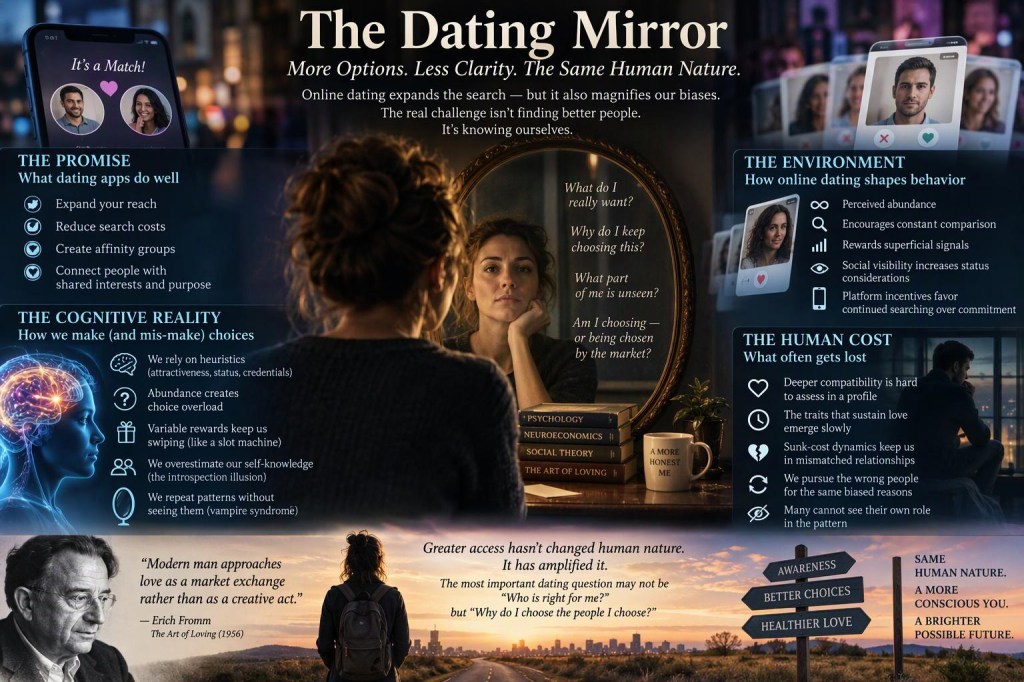
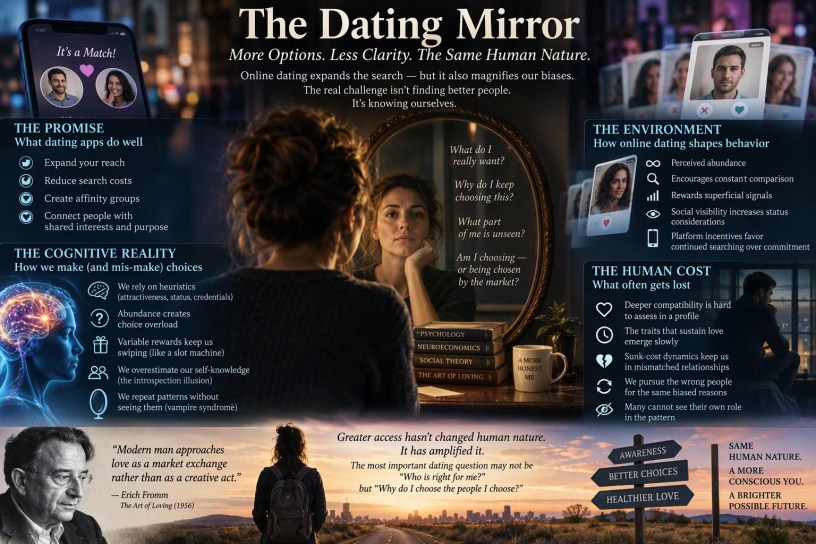
Erim Fromm in his 1958 book “The Art of Loving,” describes the tendency to use simple “heuristics”, like attractiveness and success signaling as “passivity.” For Fromm, this is a form of passivity because it substitutes external criteria for the difficult work of judgment, commitment, understanding, and care. Rather than actively engaging another person’s full humanity, one relies on social signals like, physical attractiveness, professional success, income, prestige, social desirability, validation from others. The cognitive shortcuts reduce everyone to a commodity, while giving the appearance of reducing uncertainty. Fromm would see this as a failure of mature love since both parties are not being sincere since societies values of beauty and success become the primary value-weighting, whereas in relationships one must actively encounter the other person on physical, intellectual and emotional levels. You must see as person as an entity unto themselves, not as the sum of discordant parts.
After reading Merritt Tierce’s essay “Good Enough for a Tuesday Night,” I was struck less by the economist’s behavior than by what his behavior revealed about all of us. The essay is often read as a story about beauty, status, rejection, and modern courtship, but beneath those themes lies a deeper question: How accurately do we understand our own desires and our needs in a relationship. Psychologists have long observed that people possess surprisingly limited access to the forces driving their choices. We explain our preferences after the fact, constructing narratives that portray our decisions as rational and intentional. Yet when we repeatedly pursue the same kinds of unsuitable partners, suffer the same disappointments, and enact the same relational dramas, our explanations often fail to account for the patterns. A close friend who was a director at U of P in the department of psychiatry refers to this as “vampire syndrome” since vampires can’t see themselves in a mirror. Likewise, many people move through life unable to perceive the dispositions that shape their choices. They can identify every flaw in former partners while remaining blind to the recurring element common to every failed relationship: themselves.
we need to uncouple ourselves from our intrinsic and extrinsic biases when we are trying to couple ourselves to a potential partner
Being an unusual, mostly rational actor, and having spent the last twenty-five years on dating sites, I took to the task of analyzing the construction of these sites and the psychology of single people in the dating market. I have spent hours taring into this reality from a cognitive, neuroeconomic and social theory and I have found that, while dating sites may create and “affinity group” of individuals with shared interest and purpose, they are ineffective and creating long-term relationships. As I noted in this essay, we cannot lay the blame on Match.com and Tinder, we need to uncouple ourselves from our intrinsic and extrinsic biases when we are trying to couple ourselves to a potential partner meeting them where they are, and seeing them in a “wholeistic” fashion, not as a sum of desired parts. For the record- I am no longer a participant on dating sites, and I pray that I never have to go back to that reality. I met a lovely woman, she enjoys my intellectual and philosophical renderings, having added the likes of Nietzsche, Heidegger, Kahneman, Beck to her world, we share a love of our adult children and their families, religion, life expectations, compatibility in personality and communications styles. I am really lucky to have found her, but my search was tempered by being a student of human behavior and my twenty-five years spent in the “lab” of online dating.
Stay tuned- there is more to come in this series!
A special thank you to Merril Teirce for writing an wonderful article that caused me to think! If you haven’t read it- pick up the 11/26 New Yorker Magazine